
- Google Cd-rom Driver Download For Windows 10 32 Bit
- Load Cd Rom Windows 10
- Download For Windows 10 Free
- External DVD Drive, Amicool USB 3.0 Type-C CD DVD +/-RW Optical Drive USB C Burner Slim CD/DVD ROM Rewriter Writer Reader Portable for PC Laptop Desktop MacBook Mac Windows 7/8.1/10 Linux OS Apple 4.4 out of 5 stars 4,933.
- Select your Windows 10 edition and release, and then click on the Download button below. Windows 10 Home Windows 10 Pro Windows 10 Education Windows 10 Enterprise 1507 1511 1607 1703 1709 1803 1809 1903 1909 2004 20H2.
- Download & Update DVD & CD Drivers with The World's Leading Drivers Site - Includes Free Drivers Scan & Report. Canon USB Driver Download for Windows 10, 8, 7, XP.
- Popular Hardware drivers downloads. 01 Microsoft® ODBC Driver 13.1 for SQL Server® - Windows, Linux, & macOS. The Microsoft ODBC Driver for SQL Server provides native connectivity from Windows, Linux, & macOS to Microsoft SQL Server and Microsoft Azure SQL Database. 02 Surface Pro 4 Drivers.
Addeddate 2018-10-04 23:37:00 Identifier EasyCAPCaptureCD-ROMDriver Identifier-ark ark:/13960/t1ck5p199 Scanner Internet Archive HTML5 Uploader 1.6.3.
The CD-ROM exclusive access mechanism (also known as exclusive access mode) enables applications and system components to obtain exclusive access to a CD-ROM device. Applications that require exclusive access to CD-ROM devices include the following examples:
Optical media-authoring applications
Some optical authoring software requires exclusive access to a CD-ROM device to write data without any interruption from other applications. Otherwise, data might be written incorrectly, causing data corruption.
Firmware update utilities
Many manufacturers of CD-ROM devices provide a firmware update utility. If an application sends a command to the device during a firmware update, it might make the device unusable.
Without the exclusive access mechanism, the only way for vendors to give these two types of applications exclusive access would be to install a custom filter driver that fails I/O requests from other applications and components, and this approach causes system instability. You should not use filter drivers to obtain exclusive access to CD-ROM devices.
To use the exclusive access mechanism, applications must send an IOCTL_CDROM_EXCLUSIVE_ACCESS request to the CD-ROM class driver at PASSIVE_LEVEL IRQL. When the caller makes this request, the caller must provide an identification string in the CallerName member of CDROM_EXCLUSIVE_LOCK. The class driver uses this string to identify the application that has exclusive access.
Applications should query for the current state of the device before attempting to lock it. If the device is already locked, the class driver returns the identification string of the current owner of the device. Before locking the device, the caller must open it in read/write access mode. Therefore, the caller must have administrator privileges or permission to open the CD-ROM device in write access mode.
Callers that request exclusive access should not open the CD-ROM device by simply sending a create request to the file system driver, because there is no guarantee that the CD-ROM class driver will receive the request. Instead, applications should use the SetupDiXxx routines to enumerate the interfaces for all CD-ROM devices in the system and then open the appropriate device interface.
When a caller opens a device by using the drive letter or names like CdRom0 with the access mode set to 0, the file system driver is guaranteed to pass the create request to the CD-ROM class driver. But this guarantee is still not sufficient because the handle that the application obtains by this procedure does not give the caller read/write access to the device.
Exclusive access mode has the following characteristics:
Only the owner of the exclusive access lock can access the device.
The system fails requests for access from other applications.
The system processes Plug and Play (PnP) and power I/O request packets (IRPs) in the typical way.
Media change notification is disabled for the device.
The system fails requests to open the device while it is locked.
Other applications that send an IOCTL_STORAGE_QUERY_PROPERTY request to the CD-ROM class driver will receive cached information from the device while it is locked. Specifically, if the STORAGE_QUERY_TYPE is PropertyExistsQuery, the IOCTL will behave the same as it does when the device is not locked. Also, if the STORAGE_QUERY_TYPE is PropertyStandardQuery and the STORAGE_PROPERTY_ID is StorageDeviceProperty or StorageAdapterProperty, the IOCTL returns information cached in the CD-ROM class driver. With other combinations of STORAGE_QUERY_TYPE and STORAGE_PROPERTY_ID, the IOCTL fails with the status value STATUS_ACCESS_DENIED.
Other applications that send an IOCTL_CDROM_GET_INQUIRY_DATA request to the CD-ROM class driver receive cached information from the device while it is locked, and also when it is unlocked.
The system removes exclusive access to a CD-ROM device when any of the following occurs:
The owner of the exclusive access lock sends an IOCTL_CDROM_EXCLUSIVE_ACCESS request to the CD-ROM class driver with the RequestType member of CDROM_EXCLUSIVE_ACCESS set to ExclusiveAccessUnlockDevice.
The owner of the exclusive access lock closes the device handle.
The application that owns the exclusive access lock terminates.
After removing the exclusive access lock on a device, the CD-ROM class driver takes the following actions :
Enables media change notification on the device.
Sets the DO_VERIFY_VOLUME flag in the device extension, so that the system will remount the device's file system.
Forces an update of the device's multimedia capabilities.
Google Cd-rom Driver Download For Windows 10 32 Bit
Symptoms
Your CD or DVD drive is not seen in File Explorer (called Windows Explorer in Windows 7 and earlier versions of Windows), and the device is marked with a yellow exclamation point in Device Manager. Additionally, after you open the device's Properties dialog box, one of the following errors is listed in the Device status area:
Windows cannot start this hardware device because its configuration information (in the registry) is incomplete or damaged. (Code 19)
The device is not working properly because Windows cannot load the drivers required for this device. (Code 31)
A driver (service) for this device has been disabled. An alternate driver may be providing this functionality. (Code 32)
Windows cannot load the device driver for this hardware. The driver may be corrupted or missing. (Code 39)
Windows successfully loaded the device driver for this hardware but cannot find the hardware device. (Code 41)
This issue may have occurred after one of the following situations:
You upgrade the Windows operating system.
You install or uninstall CD or DVD recording programs.
You uninstall Microsoft Digital Image.
There are various reasons why a CD or DVD drive is not detected. The resolutions that are listed in this article may help solve some instances but not all instances of this problem. You may also need to contact your hardware manufacturer for assistance with your hardware.
Resolution
For each of the following methods, click on the header, and it will open to show you more info:
Method 1: Windows 7 and 8.1 - Use the Hardware and Devices troubleshooter
For Windows 10, skip to Method 2.
In Windows 7 and 8.1, to open the Hardware and Devices troubleshooter, follow these steps:
Press the Windows logo key + R to open the Run dialog box.
Type control in the Run dialog box, then press Enter.
In the Search box in Control Panel, type troubleshooter, and then click Troubleshooting.
Under the Hardware and Sound item, click Configure a device. If you are prompted to enter an administrator password or provide confirmation, type the password or provide confirmation.
If your problem is not solved, try the next method.
Method 2: Check BIOS settings and chipset drivers
Verify the drive is activated in the BIOS. BIOS systems vary by device. If you are not sure how to verify the drive settings in your device’s BIOS, contact the manufacturer of your device.
Also, verify with the manufacturer of the computer if the drive came with it, or the manufacturer of the drive if it was purchased separately that the chipset drivers for the device are current.
If your problem is not solved, try the next method.
Method 3: Update or reinstall the driver
To update the driver, search for the driver on the device manufacturer's website, and then follow the installation instructions on the website.
To reinstall the driver, follow these steps:
Press the Windows logo key + R to open the Run dialog box.
Type devmgmt.msc in the Run dialog box, then press Enter. If you are prompted for an administrator password or for a confirmation, type the password, or select Allow
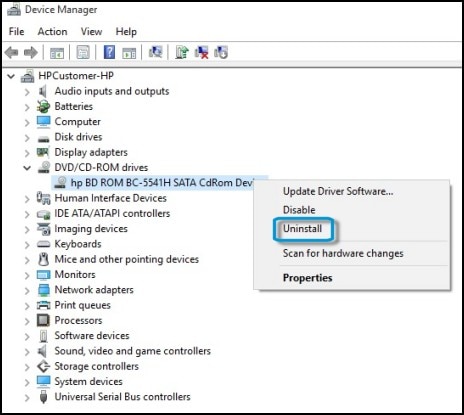
In Device Manager, expand DVD/CD-ROM drives, right-click the CD and DVD devices, and then select Uninstall.
When you are prompted to confirm that you want to remove the device, select OK.
Restart the computer.
After the computer restarts, the drivers will be automatically installed.
If your problem is not solved, try the next method.
Method 4: Remove and reinstall IDE/ATAPI drivers
To remove and reinstall IDE/ATAPI driver, follow these steps:
From Start, search for Device Manager. Open Device Manager from the search results, and select the View menu. Choose Show Hidden Devices.
Expand IDE/ATAPI Controllers, and then:
Select and right-click ATA Channel 0, and then click Uninstall
Select and right-click ATA Channel 1, and then click Uninstall
Select and right-click Standard Dual Channel PCI IDE Controller, and then click Uninstall
If there are additional entries, right-click them and then choose Uninstall
Reboot the device.
After the computer restarts, the drivers will be automatically installed.
If your problem is not solved, try the next method.
Method 5: Fix corrupted registry entries
This problem may be caused by two Windows registry entries that have become corrupted. To use Registry Editor to delete the corrupted Registry entries, follow these steps:
Press the Windows logo key + R to open the Run dialog box.
Type regedit in the Run dialog box, then press Enter. If you are prompted for an administrator password or for a confirmation, type the password, or select Allow
In the navigation pane, locate and then select the following registry subkey:
HKEY_LOCAL_MACHINESYSTEMCurrentControlSetControlClass{4D36E965-E325-11CE-BFC1-08002BE10318}
In the right pane, select UpperFilters.
Note You may also see an UpperFilters.bak registry entry. You do not have to remove that entry. Click UpperFilters only. If you do not see the UpperFilters registry entry, you still might have to remove the LowerFilters registry entry. To do this, go to step 7.On the Edit menu, select Delete.
When you are prompted to confirm the deletion, select Yes.
In the right pane, select LowerFilters.
Note If you do not see the LowerFilters registry entry, go to the next method.On the Edit menu, select Delete.
When you are prompted to confirm the deletion, select Yes.
Exit Registry Editor.
Restart the computer.
Note: To use this method, you must be logged on to Windows as an administrator. To verify that you are signed in as an administrator, bring up the Control Panel, select User Accounts, and then choose Manage User Accounts.
Important:
Follow the steps in this section carefully. Serious problems might occur if you modify the registry incorrectly. Before you modify it, back up the registry for restoration in case problems occur.
After trying this method, some apps, such as CD or DVD recording software, might not work correctly. If so, try uninstalling and reinstalling the affected app. Check with the creator of the app to see if there is an updated version.
If your problem is not solved, try the next method.
Method 6: Create a registry subkey
To create the registry subkey, follow these steps:
Press the Windows logo key + R to open the Run box.
Type regedit in the Run box, then press Enter. If you are prompted for an administrator password or for a confirmation, type the password, or select Allow.
In the navigation pane, locate the following registry subkey:
HKEY_LOCAL_MACHINESYSTEMCurrentControlSetServicesatapi
Right-click atapi, point to New, then select Key.
Type Controller0, and then press Enter.
Right-click Controller0, point to New, and then select DWORD(32-bit) Value .
Type EnumDevice1, and then press Enter.
Right-click EnumDevice1, select Modify....
Type 1 in the Value data box, and then select OK.
Exit Registry Editor.
Restart the computer.
Load Cd Rom Windows 10
Notes
To use this method, you must be logged on to Windows as an administrator. To verify that you are signed in as an administrator, bring up the Control Panel, select User Accounts, and then choose Manage User Accounts.
This method should be used on Windows 7, Windows 8 or 8.1, or Windows 10 version 1507. The issues fixed by this method shouldn’t occur in Windows 10 1511 or later.
Download For Windows 10 Free
Important: Follow the steps in this method carefully. Serious problems might occur if you modify the registry incorrectly. Before you modify it, back up the registry for restoration in case problems occur.